Why You Need to Try a Dynasty Salary Cap Fantasy League

– 6 min read

In my opinion, dynasty salary cap leagues are the best format for fantasy football! And I don’t think it’s particularly close… Here’s why!
Note: The contract examples I will be using are NOT their actual contracts in real life. The contract examples I am using are examples that would be used in a dynasty salary cap league, and the actual contracts and salaries the player has in real life have no bearing on the contracts and salaries they would have in a dynasty salary cap league.
When contracts and salaries are involved, player value takes on an entirely different form. Let me provide you with an example. Suppose you have a trade offer in a traditional dynasty league, and the offer is:
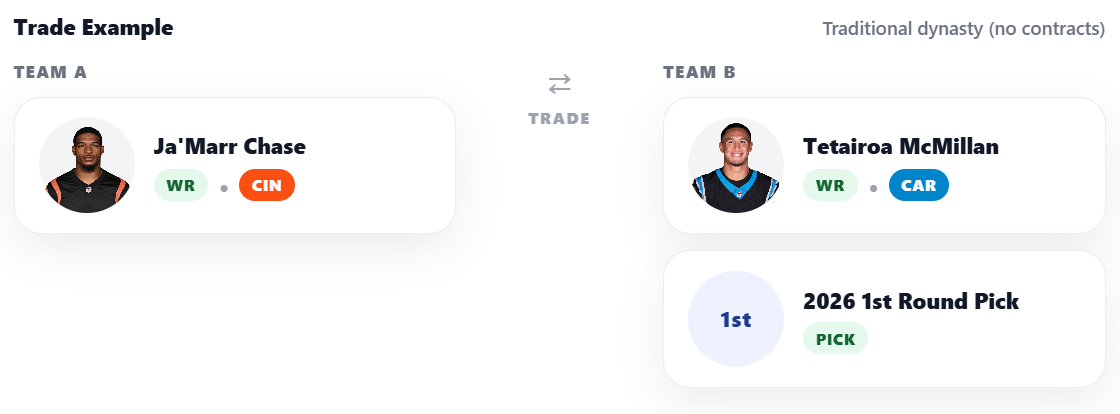
Now, looking at this trade from a traditional dynasty league standpoint, most would say this trade is not particularly close. WR Ja’Marr Chase is a top 5 dynasty asset; he is still relatively young (25 years old), and is in a very fantasy-friendly offense with him tied to QB Joe Burrow for the next 5 years at least. WR Tetaiaroa McMillan has certainly had a promising rookie season, and the 2026 1st is compelling, but I would argue most managers would feel that you would need to add at least another 1st. Now let’s look at this example with contracts involved:
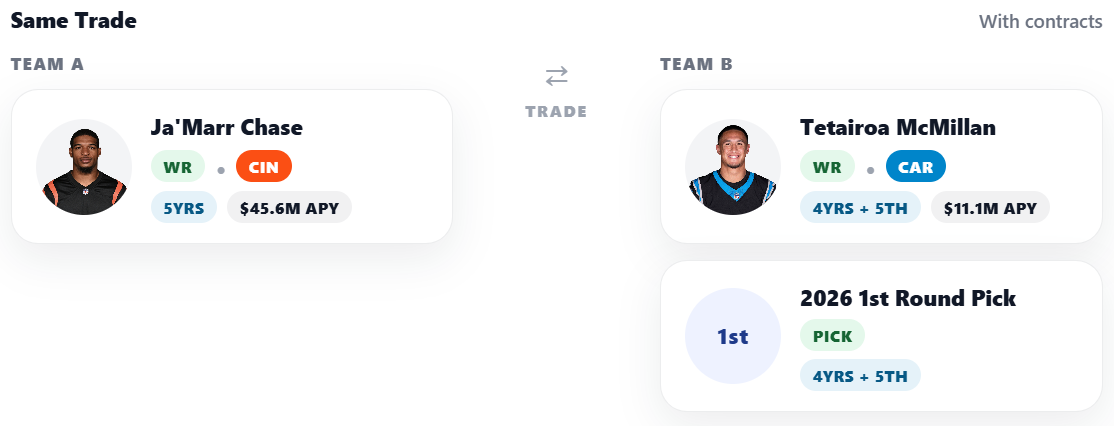
See the difference? This changes the player value drastically! The fantasy football manager has McMillan at a cost-controlled rookie contract at $11.1M APY with a 5th year option, whereas Chase is costing the other team a whopping $45.6M/year. Chase is still Chase, but in my mind, this causes me to think about this trade more. Chase is taking up 16.3% of that team's cap space, and is that team really in a position to compete? How can the Cincinnati Bengals get out of this hole in real life when 3 players (WR Ja’Marr Chase, WR Tee Higgins, and QB Joe Burrow) take up 37% of the overall team's cap space out of a 53-man roster?
Would the trade still happen even when accounting for contracts? Probably. But it's a much closer decision which is the point. Players on rookie deals make their value even more appealing and force you to compete in windows. How many times have we heard about a team with a rookie QB on their rookie deal that needs to push all their chips in before they have to pay him a ton of money?
In a traditional dynasty league, if you have drafted well, you have no incentive to switch up your roster, which leads to a lack of parity. This is purely anecdotal, but from what I can tell, you typically see dynasty league managers start to orphan their team by year 3. From there, it is only a matter of time before your dynasty league implodes, and the appeal of starting over in a new dynasty league with a new draft during the long offseason gets too appealing to pass up.
Let me give you another trade example that exemplifies how dynasty salary cap leagues take strategy to the next level. Suppose you receive the following trade:
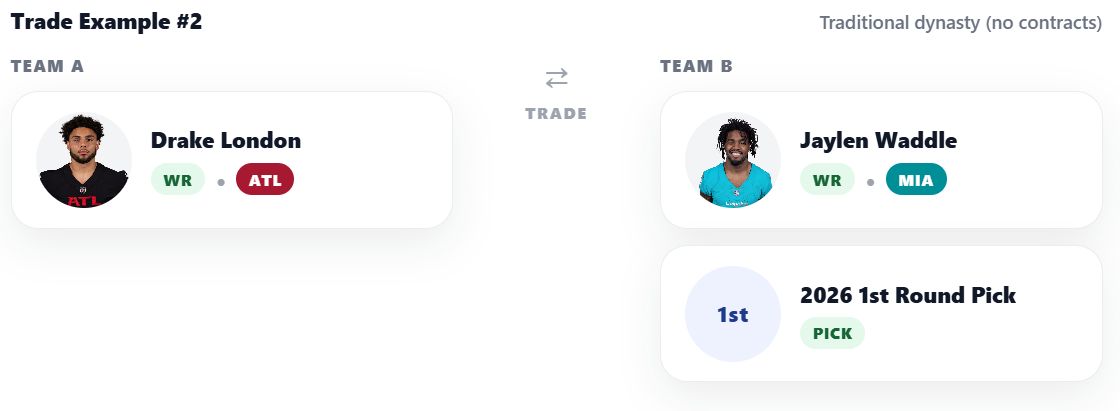
In a traditional dynasty league, the WR Drake London fantasy manager would not be inclined to make this trade. London has been solid the last two years, and year over year, he has increased his fantasy points per game. Why would that fantasy manager even consider this trade to get an older WR who is less productive? This type of trade would never go down in a traditional dynasty league. Now let’s look at this example with contracts involved:
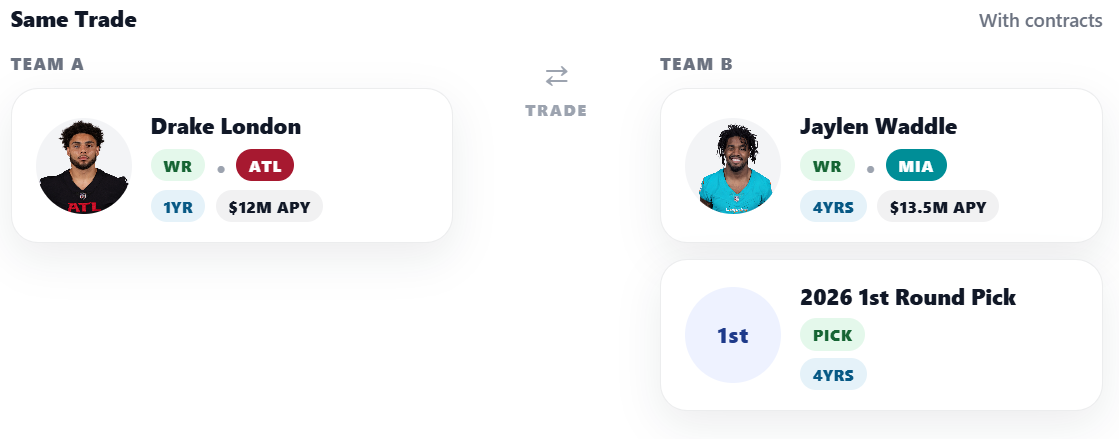
See the difference? This changes the value drastically! The fantasy football manager receives a below-market cost-controlled contract with WR Jaylen Waddle for 4 years at an average pay per year (APY) of $13.5M whereas London is set to be a free agent after the season, and he will want a boatload of money. How does $33M/yr sound to you for London for the next 5 years? Now that the fantasy manager may still be inclined to keep London for that amount, but it brings up more questions. Who is going to be the QB in Atlanta? Would they be better off getting a solid WR2 in Waddle and getting a 1st round pick to help bolster their roster?
Again, this is a case that maybe the trade still doesn’t get done, but the value is a lot closer, right? When you have players with expiring contracts, it makes you think twice if you want to pay them long-term. And if you don’t, wouldn’t you rather trade them and get something from them than have them walk away in free agency (if you have compensatory picks, this helps in that scenario)? In a traditional dynasty league, this quandary doesn’t exist. You can just keep the same players for years.
This is no exaggeration: a byproduct of having this element in your dynasty leagues is that a bad team can turn it around far more quickly. Two years ago, we had an expansion team that joined and was dead last in the standings. This year, they are the #1 seed and get a bye week.
By now, I hope you have seen the value in trying out a dynasty salary cap league. The more competitive the league, the more fun it can be. Player movement is forced when you have contracts and salaries. If I am way over the salary cap next year, what am I going to do to get under? Do I decide to offload some high contracts? Do I make some difficult cuts just to save money? Do I kick the can down the road and restructure my large contracts to expand my championship window by one year?
If you are intrigued by this format, then we have some good news for you! At Front Office Pros, we are all about dynasty salary cap fantasy football. Our Front Office Pros HQ site is dedicated creating content for this format. We are also in the process of launching a new dynasty salary cap platform, and we want you to be a part of it! If you are interested in learning more, check out our About page and make sure to subscribe to hear the latest updates as we get closer to launch! Be sure to check out our other articles on Front Office Pros for more dynasty analysis and offseason insights. For more tips on running and managing your league, explore our Fantasy Football Commissioner Guide articles.
 Steve Falco
 Steve Falco
 Admin HQ