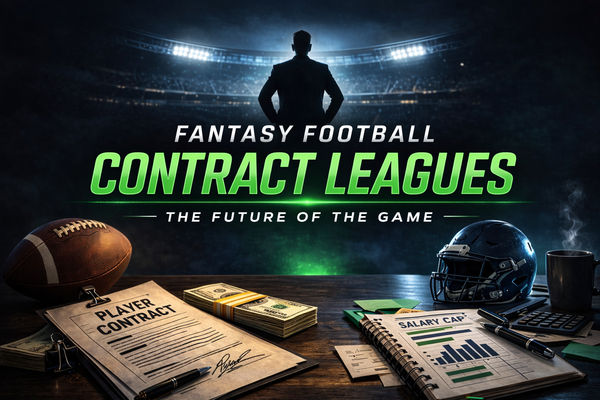
Fantasy Football (FF) popularity continues to climb, yet many veteran players feel a creeping sense of stagnation. Redraft Leagues reset too quickly, trading often feels either forced or meaningless, and eventually, Dynasty Leagues descend into predictable power hierarchies. As fantasy managers look for a format designed to mirror the complexity, strategy, and emotional pull of real NFL team-building, Contract Leagues are emerging to provide this next level…an intriguing and compelling next step in the evolution of fantasy leagues. Starting or joining a fantasy football Contract League is no longer a niche experiment. It is the most immersive, challenging, and rewarding way to play fantasy football today.

At their core, Contract Leagues introduce one transformative idea: players are not just assets, they are investments. Incorporating salaries, age, cap space, and future obligations leads to a more realistic perspective of the NFL General Manager, where each decision becomes layered, individual trades are more impactful, and every season is a chapter in the GM’s campaign strategy towards dynastic glory.

Trading Becomes Deeper, Smarter, and More Intense

One of the most immediate and noticeable upgrades in a Contract League is how dramatically trading improves. In traditional dynasty formats, trades tend to revolve around the same static variables: age, production, and future draft picks. Over time, player values often become relatively fixed, and managers often hesitate to trade unless one side clearly “wins.” This leads to long trade droughts, lopsided negotiations, or a small handful of managers dominating the market.

Contract Leagues flip this dynamic entirely.

Because every player is tied to a salary and a contract length, value becomes situational rather than universal. A wide receiver on a cheap, multi-year deal might be invaluable to a rebuilding team but expendable to a contender facing cap pressure. A veteran running back on an expiring contract might be perfect for a title push while being nearly useless to a team focused on the future. GMs live this axiom daily “trades are not simply about talent; they’re about fit, timing, and a multi-year financial strategy”.

This creates constant trade tension. General Managers aren’t just asking, “Is this player good?” They’re asking, “Is this contract good for me, right now?” Cap space becomes a trade asset. Bad contracts are offloaded for picks. Expiring deals become rental players. Trades resemble real NFL front-office negotiations, where both sides can walk away feeling like they gained something meaningful.

As a result, trading in Contract Leagues is more frequent, more creative, and far more intense. Every trade feels like a chess move, not a dice roll.

Contracts Force You to Think Like a Real GM

The defining feature of a Contract League, signing players to multi-year deals, adds a level of strategic nuance that current Dynasty Leagues simply cannot replicate. In Dynasty Leagues, retaining a player forever often becomes the default assumption. There is rarely a cost to keep a star beyond aging curves and injury risk, providing a de facto safety net. Contract leagues eliminate this safety net.

When you sign a player, you are making a prediction not just about performance, but about sustainability. You must weigh age, injury history, positional volatility, team situation, and future market value. Is it worth locking a breakout wide receiver into a long-term deal, or is this the peak before regression? Do you overpay slightly for a young cornerstone, or risk losing them back to free agency? Do you extend an aging star for one last run, knowing it could cripple your cap two years from now?

Today, real consequences rarely accompany dynasty managers’ decisions.

Contracts force difficult, authentic, and uncomfortable choices. Letting a favorite player walk because the contract no longer makes sense hurts — but that pain is part of the allure. Cutting or trading a productive player because of cap constraints adds realism and emotional weight. Success in a Contract League isn’t just about finding talent; it’s about managing risk and accepting that every decision has a cost.

The Overall Experience Is More Immersive and Rewarding

Beyond mechanics, Contract Leagues simply feel better to play. The experience mirrors real NFL fandom in a way no other format does. You build a roster with an identity. You commit to a competitive window. You feel the pressure of the salary cap. Championships feel earned not just through weekly lineup decisions, but through years of planning.

Seasons are interconnected. A championship run might be the payoff for years of careful cap management. A rebuild feels intentional rather than passive, driven by shedding contracts, accumulating picks, and preparing for free agency. Even losing seasons matter because every move sets the foundation for what comes next.

Free agency becomes an event. Unlike Dynasty Leagues, with most talent permanently rostered, Contract Leagues reintroduce uncertainty and excitement. Bidding wars emerge. Managers gamble on upside. Cap space becomes power. The offseason provides a great opportunity during the most engaging part of the year.

Contract Leagues Solve Common Fantasy Football Burnout

Many fantasy players burn out because formats feel repetitive. Redraft leagues erase long-term investment. Dynasty leagues become stagnant once elite teams hoard talent. Contract leagues strike the perfect balance between continuity and turnover.

No team can dominate forever. Bad contracts punish recklessness. Smart planning is rewarded. Even powerhouse teams must eventually make sacrifices, creating natural parity and league longevity. This keeps every manager engaged, before, during, and after each season.

Most importantly, Contract Leagues reward skill in a broader sense. Football knowledge matters, but so does financial planning, risk assessment, negotiation, and foresight. The best managers aren’t just those who draft well; the best managers are adaptable, anticipating, and outmaneuvering the competition.

The Future of Fantasy Football

Fantasy football has always been about immersion, with a close connection to the sport we love. Contract leagues take that immersion to its logical conclusion. They challenge managers to think deeper, plan longer, and engage more fully than any other format available today.

For players looking to elevate their fantasy experience, Contract Leagues aren’t just an alternative; they are an upgrade. They transform fantasy football from a game of weekly decisions into a full-scale team-building experience. And once you’ve felt the intensity of managing contracts, navigating cap space, and pulling off a perfectly timed trade, it’s nearly impossible to go back.

Contract Leagues aren’t just the future of fantasy football. For many, they’re already the best way to play. Be sure to check out our other articles on Front Office Pros for more dynasty analysis and offseason insights. For more tips on running and managing your league, explore our Fantasy Football Commissioner Guide articles.

Share this article

Share to Facebook
Share to X
Share to LinkedIn

Written by

Paul Masse
Paul Masse
X.com
YouTube